What this gesture communicates in church life
- It is a sign, not a shortcut. The gesture points to prayer, blessing, and calling.
- Scripture uses it in several settings. It appears around healing, commissioning, blessing, and ordination.
- Church traditions differ. Some treat it as sacramental, others as a strong symbolic prayer act.
- Context matters. The same movement can mean very different things depending on the rite.
- Good practice is orderly and consensual. Clear purpose and pastoral care matter more than intensity.
What this gesture means in Christian worship
I read this gesture as a public way of asking God to act through the church. It can signal blessing, healing, commissioning, or setting someone apart for responsibility, and that meaning comes from the prayer and the ecclesial context around it. A hand on a shoulder or head is not meant to be theatrical; it is meant to make an invisible reality visible.
That is why many churches pair the gesture with words of prayer, a spoken blessing, or a formal rite. The technical language some traditions use is imposition of hands, which simply means a deliberate act of placing hands for a spiritual purpose. In healthy worship, the movement never stands alone. It points beyond itself to God's presence, the church's discernment, and the person's calling.
Just as important, the gesture is not magic. It does not work because hands are physically powerful; it matters because the church is praying with intention, humility, and order. That distinction keeps the practice from becoming superstitious and helps explain why Scripture uses it in more than one setting.
That biblical pattern is the next place to look, because it shows why the church treats the gesture with such care.
Where Scripture places it and why the pattern matters
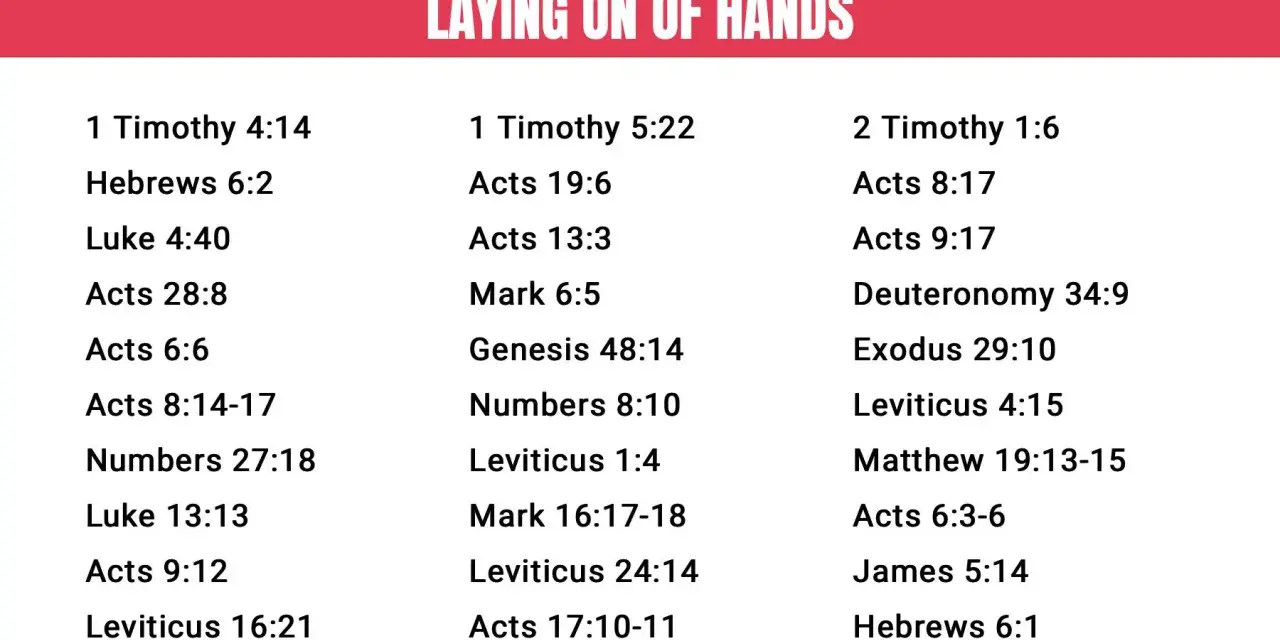
Scripture does not use this act in only one narrow way. Instead, it appears in several connected contexts, and that variety is part of what makes the gesture so enduring in Christian life.
| Scriptural setting | What the gesture does | Why it still matters |
|---|---|---|
| Blessing | Shows favor, welcome, and care | Reminds the church that blessing is personal, not abstract |
| Healing | Accompanies prayer for the sick or hurting | Connects physical touch with pastoral compassion |
| Commissioning | Sends people into a task or mission | Makes calling public and accountable |
| Ordination | Sets apart leaders for ministry | Links authority with service, not status |
| Receiving the Spirit | Marks empowerment for witness and service | Shows that ministry depends on God's gift, not personal ambition |
| Old Testament roots | Appears in blessing and consecration themes | Shows the practice is older than the New Testament church |
The bigger lesson is simple: the same outward action can carry related but distinct meanings. In one place it blesses a child, in another it sets apart a leader, and in another it accompanies healing prayer. I think that is exactly why the church should be careful with it. A gesture that can carry that much weight deserves clarity, not routine.
Once that pattern is clear, the next question is how different churches use it today and what a visitor should expect.
How Christian traditions use it now
In the United States, this gesture is most visible in confirmations, ordinations, healing services, and commissioning services. The outward movement may look similar from one church to another, but the theological meaning behind it can differ quite a bit. That is why I prefer to separate the gesture itself from the doctrine attached to it.
| Tradition | Typical use | What it emphasizes | What a visitor may notice |
|---|---|---|---|
| Catholic | Confirmation, Holy Orders, and some healing rites | Sacramental grace and apostolic continuity | Set liturgy, official prayers, and often oil or chrism |
| Orthodox | Chrismation, ordination, and healing prayer | Participation in the life of the Holy Spirit | Highly structured worship and strong ritual continuity |
| Anglican and Lutheran | Ordination, confirmation, and pastoral blessing | Church order, prayer, and public commissioning | Formal liturgy with congregational participation |
| Evangelical and Pentecostal | Ordination, healing prayer, altar ministry, and commissioning | Prayer, discernment, and the active work of the Spirit | Practice varies widely by congregation and ministry culture |
There is no honest way to flatten all of that into one explanation. In some traditions, the gesture is sacramental and closely tied to a formal rite. In others, it is a powerful prayer practice that remains symbolic rather than sacramental. Either way, the local church's teaching matters more than outside assumptions.
That is especially true if you are stepping into a service for the first time, because the right way to participate is usually simpler than people expect.
How to prepare for a prayer service that includes touch
When I look at healthy church practice, I want three things: clarity, consent, and restraint. Those are not glamorous words, but they are what keep a holy moment from becoming awkward or confusing.
- Know the purpose first. Ask whether the service is for blessing, healing, commissioning, confirmation, or ordination.
- Assume the local church has rules. In many churches, only ordained clergy or specifically authorized ministers may do the laying on of hands.
- Respect consent. No one should be pressured into physical touch, especially if they are anxious, grieving, or unsure.
- Keep the prayer brief and specific. The point is not length or intensity; it is honest intercession.
- Follow safeguarding boundaries. This is essential when children, teens, or vulnerable adults are involved.
- Stay rooted in the moment. A simple, reverent touch is usually more meaningful than a highly emotional display.
If you are receiving prayer, it helps to say what you need in plain language. If you are leading prayer, it helps to explain the moment before it happens. I have found that one short sentence can prevent a lot of confusion: what is happening, why it matters, and who will be involved.
Those habits matter because the practice can be weakened very quickly when people confuse reverence with performance.
Common mistakes that weaken the gesture
The most common mistake is treating the gesture like a spiritual switch. That mindset makes it sound as if the physical act itself guarantees an outcome. It does not. In Christian practice, the value is in prayerful obedience, not in force.
| Mistake | Why it weakens the moment | Better approach |
|---|---|---|
| Assuming it works automatically | Turns a prayer act into something mechanical | Emphasize prayer, trust, and discernment |
| Skipping explanation | Leaves people unsure about what is happening | Name the purpose before the touch happens |
| Ignoring consent or comfort | Can make worship feel intrusive | Offer clear alternatives and respect boundaries |
| Copying another tradition without formation | Creates confusion about meaning and authority | Use your own church's rite and teaching |
| Using it as a substitute for care | Can hide practical needs behind religious language | Pair prayer with pastoral support and, when needed, appropriate medical care |
I would never describe this gesture as a replacement for wisdom, treatment, or careful pastoral work. In a serious church setting, it should complement the rest of ministry, not displace it. That includes listening, follow-up, and a sober respect for what the church is actually authorized to do.
Seen clearly, the problem is not the gesture itself. The problem is using it without the maturity that gives it meaning, which leads naturally to the practical reason it still matters for churches today.
Why careful use still matters in church life
A small physical act can carry a lot of theological weight. When it is used carefully, it helps a church say, without a lot of explanation, that a person is being blessed, prayed over, sent, or set apart. That is a valuable thing in any congregation, especially in a culture where people often feel unseen.
What I find most compelling is not the movement of hands by itself, but the message behind it: God is at work, the community is paying attention, and the person in front of us matters enough to be prayed for publicly. If your church uses this rite, ask what it means in that local tradition before you participate. That one conversation usually brings more clarity than trying to guess from the outside.
Used with humility and good order, this gesture still does something churches need: it connects belief to embodied care, and it makes spiritual calling visible in a way people can remember.